EN
EN
8-Head 60cm UV DTF Crystal Label Printer: Q4 Rush Playbook
How the 60E8-UV — an 8-head Epson i3200, 60cm UV DTF crystal label printer with AB-film and direct-glue capability — helps custom label shops handle Q4 holiday volume.
8-Head 60cm UV DTF Crystal Label Printer: How Custom Label Shops Gear Up for the Q4 Rush
Every year the same thing happens. Somewhere between the first Halloween SKUs going live and Black Friday, your inbox fills with label and gift-customisation orders — and the whole year's calendar gets compressed into a few weeks of shipping deadlines. For shops that decorate bottles, gift boxes, phone cases, tumblers and packaging, the question is rarely "can we sell it?" It is "can we produce it, on time, in batches?"
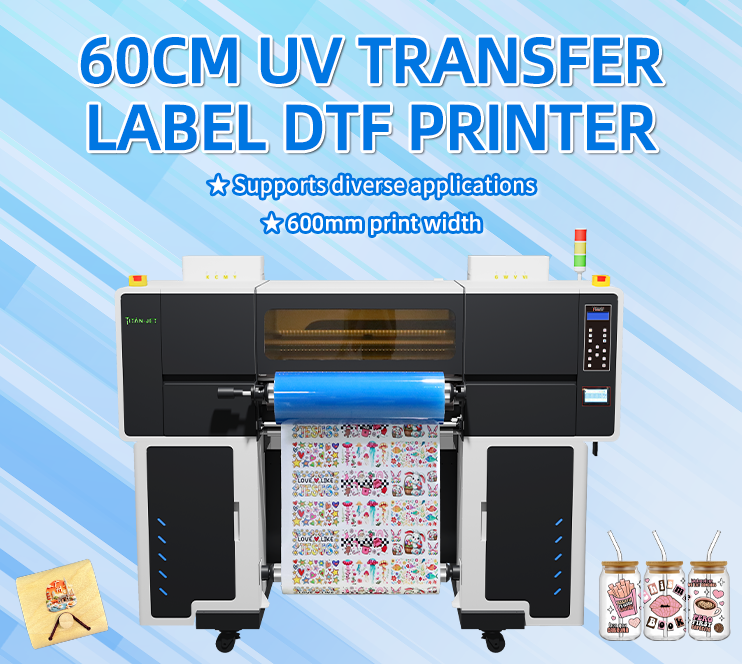
That is the problem the 60E8-UV was built around: an 8-head, 60cm UV DTF crystal label printer designed for production floors that run through the night in Q4.
Why October Decides the Year for Custom Label Shops
Holiday retail is a chain of hard deadlines. Halloween decorations and party gifts ship in early October. Thanksgiving hosts order personalised tableware and gifts in the first half of November. Black Friday and Cyber Monday push e-commerce sellers to stock finished, photographed, ready-to-ship goods. Christmas gift and packaging orders then run right up to mid-December.
For a decoration business, that means the order window is short but the volumes spike. The shops that win this season are the ones that can accept a large batch on Monday and have it packed by Thursday — without stopping production to swap machines, re-set a job, or change process mid-run.
Meet the 60E8-UV: Eight Epson i3200 Heads in a 60cm Frame
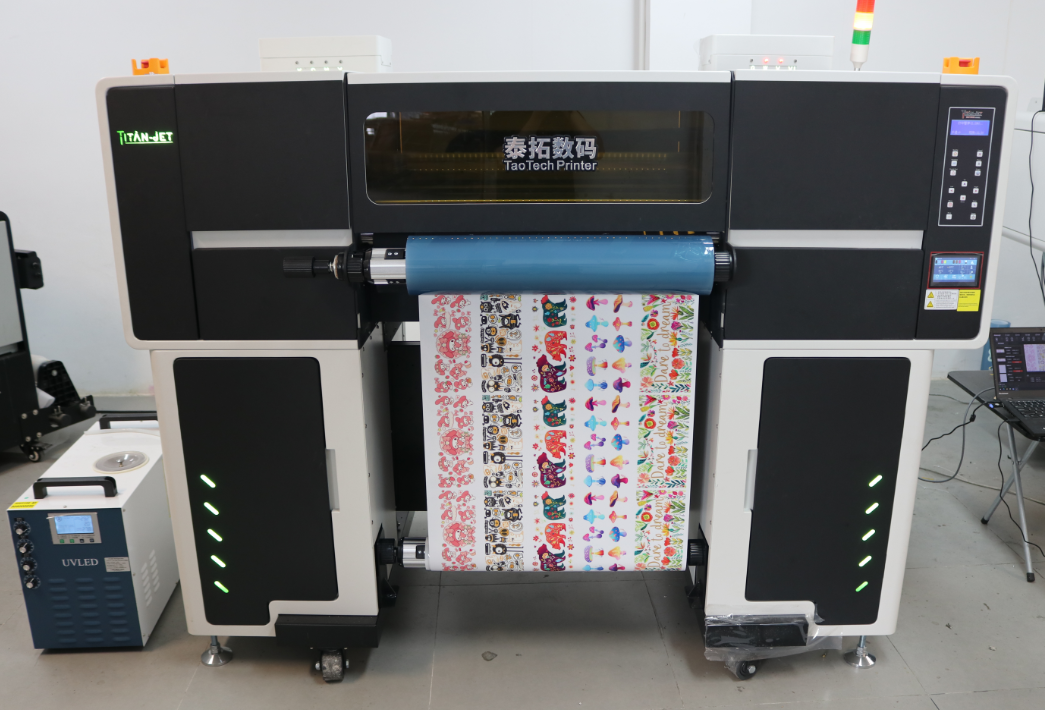
The 60E8-UV is a 60cm-wide industrial UV DTF (crystal label) printer built around eight Epson i3200 industrial printheads, a rated production-mode speed of 25 m²/h, and 2400 DPI output. Instead of one small carriage doing all the work, the head load is spread across a wider carriage assembly — which is exactly what you want when the machine is expected to run all day rather than in bursts.
The printhead configuration covers CMYK colour plus White, Varnish and Glue, so base white, colour, protective gloss and adhesive layers are produced in one pass rather than in separate steps. Finished crystal labels are printed onto release film, then transferred to the final product — peel, press, remove the carrier film, done.
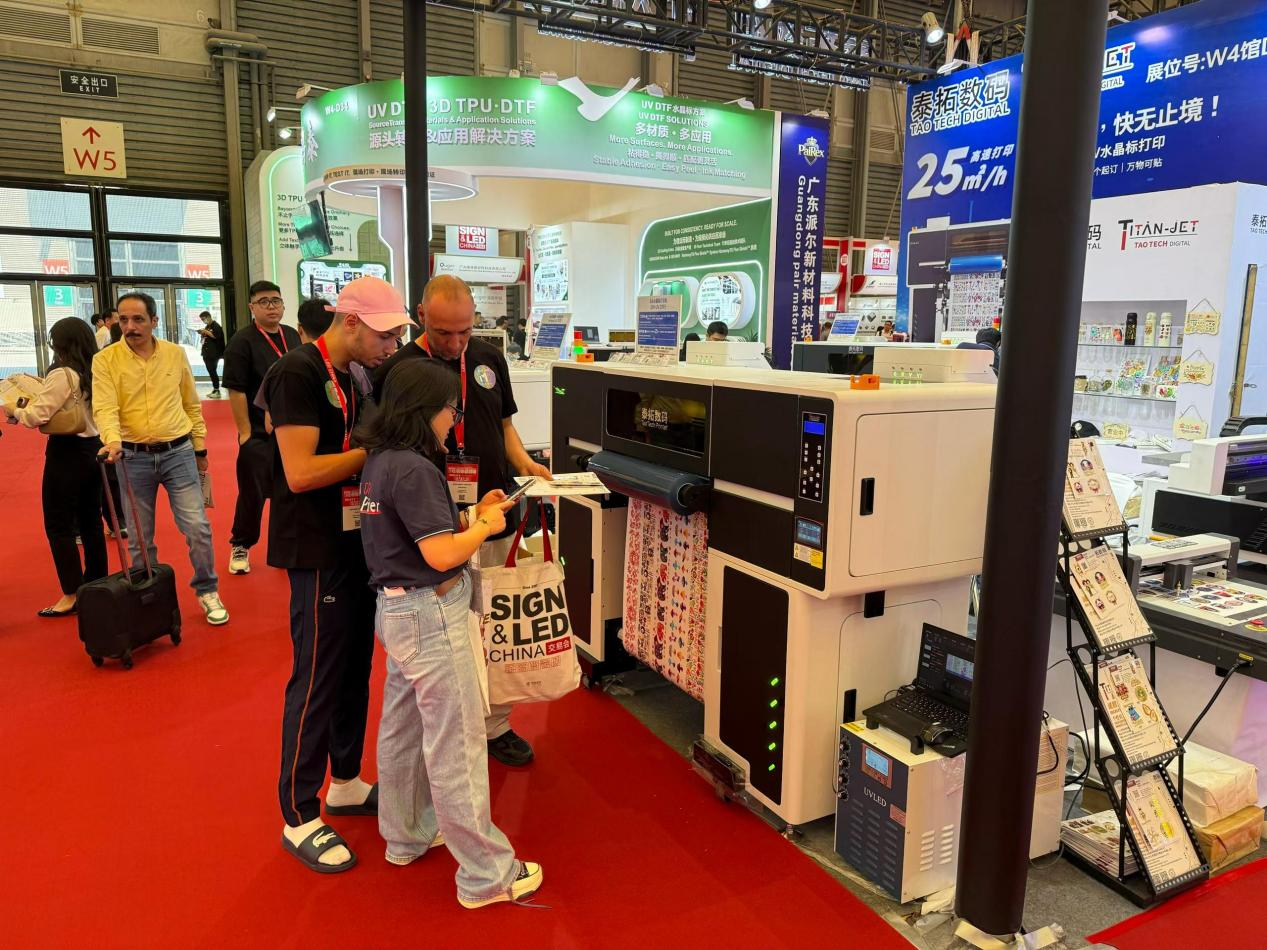
Key specifications at a glance
Printheads: 8 × Epson i3200 industrial printheads | Print width: 600 mm | Rated production-mode speed: 25 m²/h | Resolution: 2400 DPI | Colour/channel configuration: CMYK + White + Varnish + Glue | Processes: AB film and direct-glue | Ink supply: large-capacity UV ink tanks with level alarm | Platform: honeycomb widened vacuum platform | Frame: industrial heavy-duty one-piece chassis | Control board: Hansen (HS) board | Data interface: Gigabit network card | RIP software: Photoprint RIP | OS: Windows 10 or above | Power: 2050 W, 220 V, 50/60 Hz | Machine size: 1890 × 890 × 1800 mm | Net weight: 320 kg
Built for Batch Volume, Not Bench Testing
Spec sheets are easy; repeatable output is hard. Several design choices on the 60E8-UV exist specifically for continuous production:
Head load spread across eight printheads reduces the duty cycle on any single head, which supports long uninterrupted runs.
A honeycomb widened vacuum platform holds the release film flat, so larger sheets do not lift or arch at the edges — one of the most common causes of rejected sheets in batch work.
An industrial heavy-duty one-piece chassis keeps the carriage stable at speed.
Large-capacity UV ink tanks with level alarms warn you before a colour runs dry mid-job, which is the difference between a warning and a bin of wasted film.
Gigabit network data transfer keeps large variable-data jobs moving to the machine without becoming the bottleneck.
Put together, the practical constraint on your Q4 output is more likely to be your finishing, cutting and packing stations than the printer itself — which is a good problem to have when the order window is three weeks long.
One Machine, Many Finishes: Where the Equipment Savings Come From
A large share of the cost of entering crystal-label production is not the printer — it is everything you would otherwise buy alongside it. The 60E8-UV is designed to consolidate that list:
Spot foil / gold foil and cold foil transfer finishes in the same workflow, so you are not adding a separate foiling step for premium gift-box logos.
3D thick labels and embroidery-effect (3D embroidery) labels, widely used for sports crests, club marks and apparel trim.
Jelly / epoxy-drop label effects for the soft, raised look popular in accessory and stationery packaging.
Both AB film and direct-glue processes on one machine, letting you match the process to the job instead of matching the job to the machine.
AB film vs direct-glue: which process for which order
AB film process — white, colour and varnish are printed onto a pre-glued A film, then laminated with B film. Very strong adhesion, strong 3D relief, good outdoor weather resistance, clean release with no residue. Higher material cost. Best suited to premium and long-life products, outdoor signage and strong 3D relief.
Direct-glue process — glue, white, colour and varnish are printed in one go onto PP release paper. Good flexibility, can be applied directly to paper-based materials. Lower material cost, moderate weather resistance. Best suited to short-life promotional items, paper packaging and one-off products.
Being able to run both means a shop can quote high-end gift packaging and low-cost promotional runs on the same floor, without buying a second machine for either.
Materials and Applications Your Holiday Customers Ask For
Crystal labels are designed for hard, smooth surfaces, both flat and curved — which covers most of what holiday buyers actually order:
Metals: stainless steel, ironware, nameplates, flasks and tumblers
Glass and ceramic: bottles, jars, drinkware, tea tins
Wood and bamboo: gift boxes, coasters, decorative items
Packaging: rigid gift boxes, paper boxes, festive packaging
Typical Q4 applications include gift packaging, consumer electronics and 3C accessories, home décor, cultural and creative merchandise, signage and nameplates, apparel trim, and bulk e-commerce orders.
One practical note worth passing to your customers: crystal labels perform best on hard, smooth substrates. Very soft or stretchy materials such as fabric, leather and silicone are not the intended surface for this process, since adhesion and durability can suffer.
Where the Payback Comes From
We are deliberately cautious about ROI promises, because payback depends on your local selling prices, your product mix, your uptime and your labour cost — none of which we can assume for you. What we can say is where the return normally comes from:
Throughput — at a rated 25 m²/h in production mode, the machine's daily capacity is measured in hundreds of square metres across a full shift; in practice, your cutting and packing stations usually set the ceiling.
One-pass production — white, colour, varnish and glue in a single workflow removes secondary processes, drying time and handling.
No plate-making — digital UV DTF means one-off and short-run jobs are profitable, so you can say yes to the mixed, low-quantity, high-variety orders that define holiday retail.
Fewer machines — foiling, laminating and specialty effects in one unit lowers the total entry cost compared with assembling separate equipment for each step.
If you want a numbers-based view, ask our team for a volume worksheet based on your typical job sizes and shift pattern.
Two Decades Behind the Printhead
TitanJet Digital has been building wide-format and industrial printing equipment since 2006 — around two decades of in-house R&D. The company is recognised as a National High-Tech Enterprise, is an Epson strategic partner (recognised with a FY25 product sales contribution award), and holds CE and ISO 9001 certification. Its equipment serves customers in more than 100 countries. The 60E8-UV carries a one-year warranty on the complete machine.
FAQ
Q1. What is a UV DTF crystal label printer used for?
— It produces UV DTF crystal labels (also called UV stickers or transfer labels): a 3D, glossy, self-adhesive label printed on release film that is transferred onto a product surface by hand. Typical uses are gift packaging, drinkware, bottles, electronics accessories, signage and promotional items.
Q2. How fast is the 60E8-UV, and how much can it produce per shift?
— The rated production-mode speed is 25 m²/h at 2400 DPI across a 600 mm width. Output per shift depends on job size, layout efficiency, curing and finishing time — our team can help you estimate it for your specific product mix.
Q3. What is the difference between the AB film process and the direct-glue process?
— AB film gives stronger adhesion, deeper 3D relief and better outdoor weather resistance, at a higher material cost. Direct-glue prints the adhesive layer along with white, colour and varnish onto release paper, offering more flexibility and the ability to apply directly to paper-based materials. The 60E8-UV supports both.
Q4. Which materials can the finished labels be applied to?
— Hard, smooth surfaces, flat or curved, including stainless steel, ironware, glass, ceramic, wood, bamboo, acrylic, plastic and paper packaging.
Q5. What ink and colour configuration does it use?
— CMYK colour plus White, Varnish and Glue, supplied from large-capacity UV ink tanks with level alarms to reduce mid-job interruptions on long batch runs.
Q6. What support and warranty come with the machine?
— The complete machine carries a one-year warranty. As a manufacturer with roughly two decades of R&D experience, TitanJet supports installation, training, spare parts and remote technical assistance through its international service network.
Get Your Q4 Line Ready Before the Rush
The cheapest machine is the one that arrives too late. If you want your production line settled, tested and running before the Halloween-to-Christmas order wave, the time to plan is now.
Talk to the TitanJet team about the 60E8-UV — request a live demo, a sample label set on your own product surface, and a capacity worksheet for your typical Q4 job mix.